
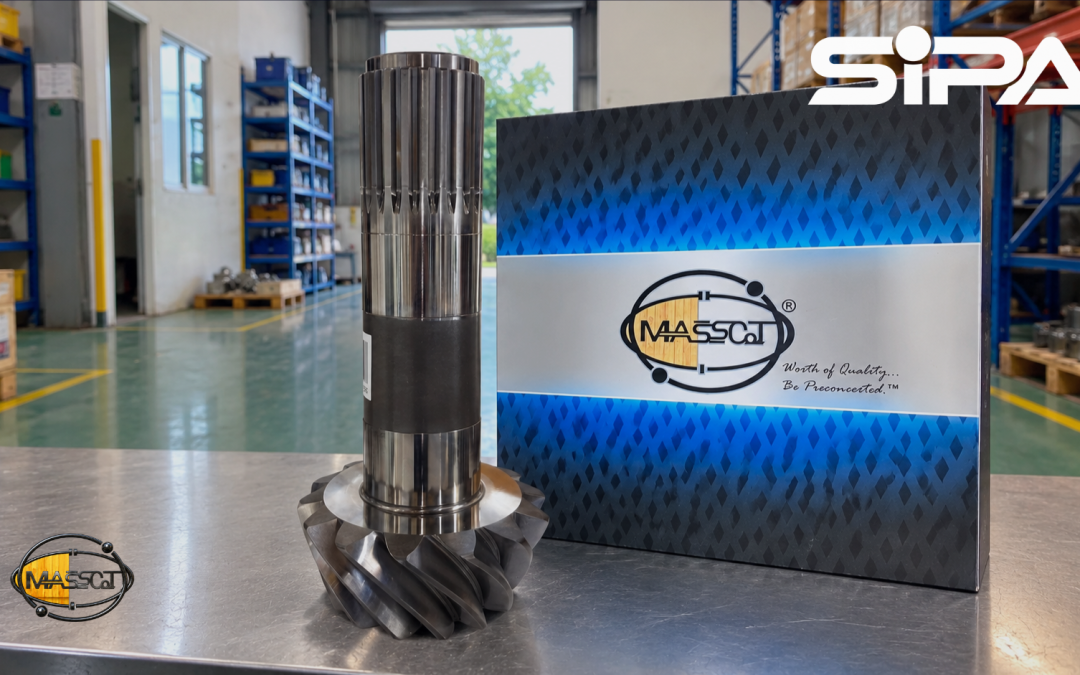
In heavy-duty equipment, power must be transferred efficiently from the drivetrain to the wheels under continuous and often demanding loads. One of the components involved in this process is the pinion gear.
Although relatively compact compared with other drivetrain components, the pinion gear operates under repeated contact and load. Understanding its function, common wear patterns, and key inspection points can help maintenance teams identify potential problems before they develop into more serious drivetrain issues.
What is a Pinion Gear
A pinion gear is a gear that works together with a mating gear to transfer rotational force within a drivetrain system. In a differential assembly, the pinion gear helps transmit power toward the differential gear set before torque is distributed to the drive wheels.
Because the gear teeth remain in repeated contact during equipment operation, their condition and alignment are important to maintaining smooth power transmission.
In heavy equipment operating under high loads, this makes the pinion gear one of the components worth monitoring as part of drivetrain inspection and maintenance.
Why Pinion Gear Condition Matter
Heavy equipment used in mining and hauling applications regularly operates under conditions such as high loads, long operating cycles, uneven terrain, and changing operating demands.
These conditions can place significant stress on drivetrain components over time.
Wear does not always result in immediate component failure. It can develop progressively, which is why condition monitoring and scheduled inspections are important.
Komatsu notes that monitoring wear trends can help identify abnormal conditions before they develop into major failures, allowing maintenance decisions to be made based on equipment condition rather than waiting for breakdown.
Common Signs of Pinion Gear Wear
Several conditions may indicate that a gear set requires closer inspection.
1. Abnormal Gear Noise
Changes in drivetrain noise can indicate changes in gear contact, alignment, bearing condition, or other components within the assembly.
A new whining, grinding, or unusual mechanical sound should therefore not automatically be attributed to the pinion gear alone. Instead, it should prompt further inspection of the drivetrain system.
2. Pitting on Gear Teeth
Repeated contact stress can eventually produce small pits on gear-tooth surfaces.
The severity and distribution of surface damage matter. Inspection should consider whether the condition is localized, stable, or progressing across the contact area.
3. Scuffing or Surface Damage
Gear-tooth surfaces can also experience scuffing. In more severe cases, material can be transferred or displaced from the tooth surface, producing rough or visibly damaged contact areas.
Progressive scuffing should not be ignored because it can continue to develop if the operating condition responsible for it remains unchanged.
4. Abnormal Wear Pattern
Gear teeth should also be checked for unusual or uneven contact patterns.
An abnormal pattern may warrant further investigation of alignment, supporting components, lubrication, and the overall condition of the gear set rather than replacing an individual component without determining the cause.
5. Lubricant Contamination or Wear Particles
Not every developing gear problem is immediately visible from the outside.
Lubricant condition can provide useful information about what is happening inside a drivetrain or gear assembly. Wear particles and contaminants detected through oil analysis can help maintenance teams recognize abnormal wear trends.
Komatsu uses this principle in its Oil and Wear Analysis program, where lubricant analysis is used to identify changes in wear and contamination before they develop into more serious equipment problems.
What Should Be Checked During Inspection
Pinion gear inspection should not focus only on whether a tooth is visibly broken.
Maintenance teams can consider several areas:
Gear Tooth Surface — Check for visible pitting, scuffing, cracking, abnormal polishing, or other surface damage.
Contact Pattern — Look for unusual or uneven areas of contact across the gear teeth.
Lubricant Condition — Check for contamination, abnormal particles, or changes in lubricant condition.
Supporting Components — Bearings, mating gears, and related components should also be considered because gear performance depends on the condition of the complete assembly.
Operating History — Changes in noise, vibration, operating load, maintenance history, and previous inspection results can provide additional context.
Visual gear inspection, oil analysis, vibration analysis, and other condition-monitoring methods are among the approaches used in heavy-equipment technical inspections.
Inspection Should Be Preventive, Not Reactive
Waiting until a drivetrain component fails can turn a manageable maintenance issue into unplanned equipment downtime.
A better approach is to monitor component condition over time and investigate meaningful changes before they progress.
Periodic inspection and condition monitoring can help maintenance teams plan repairs and component replacement around equipment condition. Komatsu similarly emphasizes preventive inspection and wear monitoring as ways to identify potential problems and reduce unplanned repairs.
For equipment working in demanding or high-utilization environments, inspection frequency may also need to reflect actual operating conditions rather than relying on a single interval for every machine. Komatsu notes that factors such as criticality, environmental conditions, extreme load variations, and operating conditions can influence monitoring requirements.
Pinion Gear for Komatsu HD785-7
For Komatsu HD785-7 applications, correct part identification is important when sourcing drivetrain replacement components.
MASSCoT provides Pinion Gear Assembly P/N 561-22-71206, with P/N 561-22-71207 identified as the latest P/N for 561-22-71206.
Before ordering a replacement component, the required P/N and equipment configuration should be confirmed to ensure the correct application.
Keep the Drivetrain Ready for Demanding Operations
Pinion gear condition is only one part of overall drivetrain reliability. Regular inspection, correct lubrication, condition monitoring, and accurate part identification can help maintenance teams recognize developing issues and make better-informed maintenance decisions.
For information regarding MASSCoT Pinion Gear Assembly 561-22-71206 / 561-22-71207 for Komatsu HD785-7,
Contact Us
Email: sales@sipa.co.id
Website: sipa.co.id